The signal lies within the bond market, where investors show how confident they are about the economy by their level of demand for U.S. government bonds.
It's called the "yield curve," and a significant part of it flipped Friday for the first time since before the Great Recession: A Treasury bill that matures in three months is yielding 2.45 percent – 0.02 percentage points more than the yield on a Treasury that matures in 10 years.
It seems illogical. Economists call it an "inverted" yield curve. Normally, short-term debt yields less than a long-term debt that requires investors to tie up their money for a prolonged period. When a short-term debt pays more than a long-term debt, the yield curve has inverted.
And when the yield curve is inverted, it shows that investors are losing confidence in the economy's prospects.
Why is the Dow falling?: Banks and tech stocks drag down market on Wall Street
Papa John's new ambassador: Shaquille O'Neal will be the face of pizza chain
Why you should careThis warning signal has a fairly accurate track record. A rule of thumb is that when the 10-month Treasury yield falls below the three-month yield, a recession may hit in about a year. Such an inversion has preceded each of the last seven recessions, according to the Federal Reserve Bank of Cleveland.
The last time a three-month Treasury yielded less than a 10-year Treasury was in late 2006 and early 2007, before the Great Recession made landfall in December 2007.
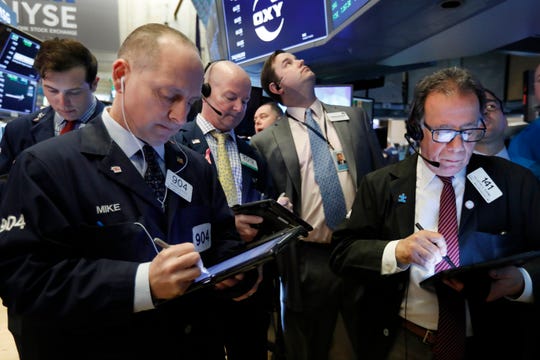
Traders gather on the floor of the New York Stock Exchange on March 13, 2019. (Photo: Richard Drew, AP)
Why did the yield curve invert?Longer-term Treasury yields have been falling this year, in part on worries that economic growth is slowing around the world. When investors become nervous, they often abandon stocks and other risky assets and flock to Treasurys, which are among the world's safest investments. High demand for bonds will, in turn, send yields falling. Accordingly, the yield on the 10-year Treasury has sunk to 2.43 percent from more than 3.20 percent late last year.
Shorter-term rates, by contrast, are influenced less by investors and more by the Federal Reserve, which raised its benchmark short-term rate seven times over the past two years. Those rate hikes had been forcing up the three-month yield, to 2.45 percent from 1.71 percent a year ago. This momentum will likely slow now that the Fed foresees no rate hikes in 2019. But if longer-term Treasury yields continue to weaken, the curve could remain inverted.
Is it a perfect predictor?NEWSLETTERSGet the Managing Your Money newsletter delivered to your inboxWe're sorry, but something went wrongA collection of articles to help you manage your finances like a pro.Please try again soon, or contact Customer Service at 1-800-872-0001.Delivery: FriInvalid email addressThank you! You're almost signed up for Managing Your MoneyKeep an eye out for an email to confirm your newsletter registration.More newsletters
No, an inverted yield curve has sent false positives before. The yield curve inverted in late 1966, for example, and a recession didn't hit until the end of 1969.
Haven't we heard this before?Other parts of the yield curve inverted late last year, as when the five-year Treasury's yield dropped below the three-year yield. Those parts of the yield curve, though, aren't as closely watched.
And not every part of the yield curve is inverted. Many traders on Wall Street also pay close attention to the difference between two-year and 10-year Treasurys. That part of the curve is still not inverted. The 10-year yield of 2.43 percent is still above the two-year yield of 2.32 percent.
FacebookTwitterGoogle+LinkedInWho is the most famous stock trader on Wall Street? Fullscreen Post to FacebookPosted!
A link has been posted to your Facebook feed.
 Trader Peter Tuchman works on the floor of the New York Stock Exchange, Monday, March 18, 2019. Richard Drew, APFullscreen
 Trader Peter Tuchman laughs as he works on the floor of the New York Stock Exchange, Wednesday, March 13, 2019. U.S. stocks opened broadly higher on Wall Street Wednesday, powered by technology and health care companies, as the market pushes for its third straight day of gains. Richard Drew, APFullscreen
 Trader Peter Tuchman works on the floor of the New York Stock Exchange, Tuesday, March 5, 2019. Stocks are opening slightly lower on Wall Street led by losses in banks and technology companies. Richard Drew, APFullscreen
 In this Jan. 30, 2019, file photo trader Peter Tuchman smiles as he poses with an old "Dow 25,000" hat on the New York Stock Exchange trading floor. Richard Drew, APFullscreen
 Trader Peter Tuchman wears a hat he had made that reads 'DOW 19,000' on the floor of the New York Stock Exchange in New 22 Nov.22 2016. The Dow Jones industrial average hit 19,000 during morning trading. Justin Lane, European Pressphoto AgencyFullscreen
 Peter Tuchman, a trader with Quattro M Securities, works from a handheld computer during the first day of trading at the New York Stock Market, Jan. 3, 2012 . Bebeto Matthews, APFullscreen
 Trader Peter Tuchman works on the floor of the New York Stock Exchange, Jan. 19, 2016. U.S. as stocks opening higher, led by gains in banks and technology companies. Richard Drew, APFullscreen
 Traders Peter Tuchman, and Sal Suarino gather with others at a post on the floor of the New York Stock Exchange May 27, 2014. Stocks rose after the government reported that orders for big-ticket items rose unexpectedly last month. Richard Drew, APFullscreen
 Trader Peter Tuchman leaves the trading floor of the New York Stock Exchange June 12, 2012. The stock market suffered its worst day of the year after a surprisingly weak report about hiring and employment cast a pall of gloom over the U.S. economy. Richard Drew, APFullscreen
 Trader Peter Tuchman takes a breather on the floor of the New York Stock Exchange 18, 2015 at the closing bell. Timothy A. Clary, AFP/Getty ImagesFullscreen
 Trader Peter Tuchman, works on the floor of the New York Stock Exchange, Oct. 5, 2016. 13, 2015. Andrew Burton, Getty ImagesFullscreen
 Trader Peter Tuchman rubs his head as he works or the floor of the New York Stock Exchange, July 26, 2007. Wall Street suffered its second-biggest plunge of the year leading global markets lower as investors fled stocks amid increasing uneasiness about the mortgage and corporate lending markets. The Dow Jones industrials briefly fell more than 400 points, while Treasury yields plunged as investors moved money into bonds. Richard Drew, APFullscreen
 Trader Peter Tuchman throws his hands in the air at the closing bell of the New York Stock Exchange July 31, 2014. John Moore, Getty ImagesFullscreen
 Trader Peter Tuchman wears his "Dow Almost 20,000" cap as he works on the floor of the New York Stock Exchange, Dec. 15, 2016. Stocks are opening moderately higher on Wall Street and the dollar is making more gains against other currencies a day after the Federal Reserve raised its benchmark interest rate. Richard Drew, APFullscreen
 Trader Peter Tuchman jokes while wearing a handmade "Dow 17,000" cap as he works on the floor of the New York Stock Exchange July 1, 2014. The stock market climbed to all-time highs after reports showed that manufacturing in the US and China expanded in June, boosting the outlook for global growth. Netflix jumped after analysts at Goldman Sachs raised their outlook on the stock. Richard Drew, APFullscreen
 Trader Peter Tuchman works on the floor of the New York Stock Exchange, July 17, 2017. Richard Drew, APFullscreen
 Trader Peter Tuchman, works on the floor of the New York Stock Exchange, Oct. 5, 2016. Richard Drew, APFullscreen
 Singer Jordin Sparks talks with trader Peter Tuchman during her visit to the floor of the New York Stock Exchange, Aug. 21, 2015, before ringing the closing bell to celebrate the release of her third album, ÒRight Here, Right Now.Ó Richard Drew, APFullscreen
 Trader Peter Tuchman works on the floor of the New York Stock Exchange, as stocks are opening higher on Wall Street, a day after the Dow Jones industrial average closed at its second all-time high in a week, April 10, 2013. Richard Drew, APFullscreen
 Trader Peter Tuchman works on the floor of the New York Stock Exchange, June 5, 2015. Richard Drew, APFullscreen
 Trader Peter Tuchman studies his handheld device Feb. 23, 2009. Richard Drew, APFullscreen
 Trader Peter Tuchman pushes back his hair as he works on the floor of the New York Stock Exchange, Aug. 9, 2007. Wall Street plunged after a French bank said it was freezing three funds that invested in U.S. subprime mortgages because it was unable to properly value their assets. The Dow Jones industrials extended its series of triple-digit swings, this time falling more than 380 points. Richard Drew, APFullscreen
 Trader Peter Tuchman watches a screen above the floor of the floor of the New York Stock Exchange at the closing bell, Oct. 15, 2014. The Dow Jones industrial average plummeted as much as 460 points in afternoon trading, then clawed back much of the ground it lost. It ended down 173 points, or 1.1 percent. Richard Drew, APFullscreen
 Traders Peter Tuchman, left, and Gregory Rowe Sept. 18, 2013. Richard Drew, APFullscreen
 Trader Peter Tuchman rubs his head as he works on the floor of the New York Stock March 13, 2007. Stocks plunged driving the Dow Jones industrials down more than 200 points and erasing all the gains made last week as troubles for subprime lenders piled up. Richard Drew, APFullscreen
 Trader Peter Tuchman smiles as he works on the floor of the New York Stock Exchange March 5, 2013. Richard Drew, APFullscreen
 Trader Peter Tuchman, Oct. 14, 2008. Richard Drew, APFullscreenInterested in this topic? You may also want to view these photo galleries:Replay
 1 of 27
 2 of 27
 3 of 27
 4 of 27
 5 of 27
 6 of 27
 7 of 27
 8 of 27
 9 of 27
 10 of 27
 11 of 27
 12 of 27
 13 of 27
 14 of 27
 15 of 27
 16 of 27
 17 of 27
 18 of 27
 19 of 27
 20 of 27
 21 of 27
 22 of 27
 23 of 27
 24 of 27
 25 of 27
 26 of 27
 27 of 27AutoplayShow ThumbnailsShow CaptionsLast SlideNext SlideSo is a recession coming or not?
It's too soon to say. Economic growth is slowing around the world, but the U.S. job market remains relatively strong.
"This is a signal that we should take seriously," said Frances Donald, head of macroeconomic strategy at Manulife Asset Management. "However, it's too early to tell whether this is indeed a harbinger of a recession or a blip. For me to feel confident to say this is a predictor of recession, I would need to see it persist for at least one to two months."
Potentially more concerning, Donald said, is how businesses and consumers react to the inverted yield curve. If they were to cut back on hiring or spending, that could trigger a self-fulfilling prophecy that leads to a recession.
"We're so accustomed to this telling us a recession is ahead that my concern is businesses and households get so scared they effectively create one," she said.

No comments:
Post a Comment