Tuesday, May 29, 2018

Bayer to sell off $9 billion in assets as part of Monsanto takeover

The Department of Justice has approved a multi-billion dollar merger between Bayer and Monsanto that will create one of the world's largest agrichemical companies.

The merged company will have to divest approximately $9 billion in businesses and assets as part of the deal.

It's the "the largest divestiture ever required by the United States in a merger enforcement proceeding," said Antitrust Division Chief Makan Delrahim.

Bayer, which offered $66 billion for Monsanto, will sell its divested assets and companies to BASF (BASFY), a chemical and crop protection company. Bayer had previously announced that it reached a deal with BASF.

Bayer and Monsanto have agreed to the government's divestiture terms, according to Delrahim. The merger will now undergo a 60-day public comment period, after which a judge is expected to sign off on the deal including the government's conditions.

Bayer (BAYRY)will divest its entire seed business, including cotton, canola, soybean and vegetable seeds, and also its herbicide assets including the Liberty brand, which is a competitor to Monsanto's Roundup.

The DOJ also requires the divestiture of intellectual property, including R&D projects, and Bayer's "digital agriculture" business to develop new farm technologies to maximize crop yield.

The German company Bayer and Monsanto (MON), an agricultural company based in St. Louis, first announced their merger agreement in 2016. The DOJ's antitrust division has been investigating the merger on concerns that it would drive up seed prices, which would impact farmers as well as consumers.

Bayer, which is strongest in Asia and Europe, stands to gain from Monsanto's expertise in agriculture and seeds. It would also benefit from the U.S. company's big presence in North America.

Bayer has said combining the companies would generate synergies of $1.5 billion over three years.

But Bayer is buying Monsanto at a desperate time for American farmers. US farm profit fell to $61 billion in 2016, the lowest since 2006, and less than half the income farms earned in 2013, according to the USDA.

The deal is the latest mega-merger aimed at reshaping the agribusiness and chemical sectors.

Neither Monsanto, Bayer or BASF immediately returned messages from CNNMoney.

CNN's Jethro Mullen and Charles Riley contributed.

Monday, May 28, 2018

Decoding Activision Blizzard's Call Of Duty Game-Play Reveal

Introduction: An avid Gamer��s take on Activision Blizzard

As a freshman college student who has been an active member of the video gaming community since 2009, I am more than excited to share my thoughts on Activision Blizzard (NASDAQ:ATVI) and what its recent catalyst on May 17th, the Call of Duty: Black Ops 4 (COD: BO4) game-play reveal, means for shareholders and/or other related parties. Having initially been captivated by playing popular first-person shooter games (Halo 3: ODST and Call of Duty: Modern Warfare 2), I have been continuously observant of the environment in which they have developed in for the past nine years. The most acute observations, however, have been made with regards to the effect that social media platforms such as Twitter, YouTube, and Twitch have had and will continue to have on the commercial success of video games and their respective ��ecosystems�� for which game publishers are increasingly focused on crafting.

This article will serve to formulate predictions on how the features evinced by the game-play reveal of the game COD: BO4 on May 17th, 2018 will affect the commercial launch of the game itself. Specifically, these features will have an impact on the amount of purchases for the game during its release date on October 12th, 2018, as well as the users who engage in microtransactions��the purchase of additional virtual player customizations��because of it. Based on a sentiment analysis of the video gaming community, I will determine the degree and direction for which these impacts may be qualified by. The predictable sentiment that the gaming community will maintain towards COD: BO4 based on its recent game-play reveal will have an effect on the game��s reception come its release October 12th, 2018. In turn, this will portend the quantity of future revenues and the direction of Activision��s share price.

Call of Duty Development Process

Call of Duty has been the #1 top grossing console gaming franchise in North America for a staggering nine years in a row, and worldwide eight out of the last nine years.

Call of Duty (COD) is a gaming franchise and each iteration of it, in the form of an additional game, is published every year by Activision. However, there are three different video game developers, nominally, Treyarch, Infinity Ward, and Sledgehammer who distinguish their creation of each yearly COD release based on their particular aptitudes or the features that they are known for developing well. The three COD video game developers alternate in developing each year��s continuation of the COD franchise in a predictable manner based on which developer least recently spent their labor-power on developing one of the past three COD releases: the COD franchise operates in three-year cycles which experience each developers�� version of the game. This year��s COD developing obligations have been bestowed upon video game developer Treyarch. Treyarch��s goodwill comes in the form of the particular features most coveted by users (Zombies mode, weapon caches, map design, virtual player customization) which Treyarch��s aptitude for developing them is greater than the other two developers. This paradigm is reflected in the largely demanded ��Black Ops�� theme attached to this year COD franchise. (The ��Black Ops�� brand should not be overlooked and it will be useful in understanding arguments which support Activision��s position in the video game market irrespective of the features that the COD��s game-play reveal has displayed).

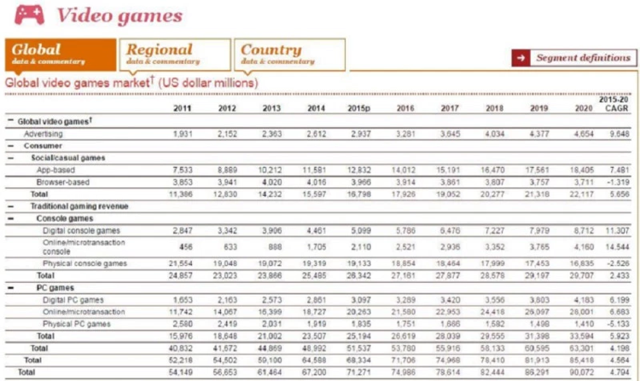
Additionally, each COD version is given a date for the ��game-play reveal��, in which members at both the nexus and fringe of the gaming community gawk or scorn at the newly released visuals and/or conceptual dynamics of the game. What follows is a period, historically 5-6 months, in which the game is publicized until its official date at which time the consumer may begin to play it. As mentioned previously, the revenue incurred by video game publishers such as Activision doesn��t stop at per-unit sales. ��Microtransactions�� in which users pay for either single player or multiplayer customizations towards an in-game experience, contribute significantly to operating revenues. This is a crucial observation illustrative of our conviction in the growth of Activision as an economic actor within the video gaming industry. The player retention and origination that I foresee Call of Duty: Black Ops 4 producing will indicate disproportionate growth between ��in-game�� microtransactions and any increase in individual COD game sales as to comprise a greater part of Activision��s revenues. I will begin by addressing the theoretical "free-to-play" model (FTP) which is exercised by video games like ��Fortnite�� who rely upon microtransactions as their sole source of revenue: as it remains a most likely progression in the evolution of video game business economics. After such, I will return to why Activision��s most recent game-play reveal will benefit from such a hypothesis.

Fortnite Anecdote (Transforming EBITDA Producing Dynamics)

Fortnite has taken over the video game industry the past 8 months as its FTP model across numerous platforms (PC, XB1, PS4, Mobile) has given everyone that wishes to play the game the ability to do so in whatever hardware form. Fortnite creators and all other parties involved subsumed a ��game as a service�� business model. They opted to monetize their content after the game��s official release of its FTP interface and in doing so stomached an immense risk by having an unassured amount of per unit game sales to remotely recoup game development and S&M expenses. However, this wager has paid off as Fortnite has become the most played and viewed video game at the moment, recording $296 million in revenue for the month of April alone. Fortnite��s recent form of success is amusingly indicative of the video game sector��s increasingly profound transition to rely upon microtransactions from per unit product sales as means to bolster their operating revenue
Released Images, Features Hypothesis, Sentiment Analysis

As previously mentioned, I will review the released features of COD: BO4 vis-�-vis video streams from the game-play reveal on May 17th and the sentiment or speculation that surrounds what they mean for the game. Each heading which alludes to either a feature or which impacts customers�� expectations and the significance of the game itself as it has been revealed, will be categorized as either positive, negative, or neutral, or a combination thereof, with respect to Activision��s price per share prospects.

��Boots on the Ground�� Theme

The upcoming COD game will take place in a setting commonly known as ��boots on the ground��. A ��boots on the ground�� theme is characterized by virtual players�� inability to leave the ground without aid from a contemporary air vehicle. It is suggestive of a ��modern�� setting which would exclude futuristic themes, such as those allowing for jetpack-related functions which have been previously adopted by some of the franchise��s other versions. Additionally, this version��s game-play reveal has added special character abilities, or ��specialists�� to the game. These features are unique abilities that can be expended and regenerated on the basis of a ��cool-down�� timer: once one uses a ��special�� ability they might have to wait for a few minutes before they can use it again. This is precisely what the general COD community has expressed desired for these past few quarters. (Moderate Positive)

Semblance to Call of Duty: Black Ops 3 (COD: BO3)

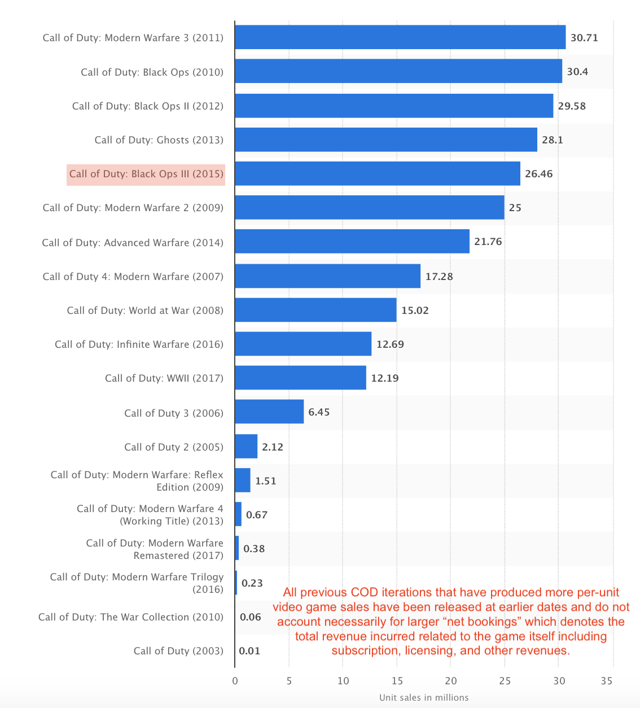
COD: BO3 has been a commercially successful version of the COD franchise and the most played ��advanced movement�� COD game so far. (Advanced movement is a movement style from the COD franchise that includes the use of some technology to enhance a player's mobility by either giving them the ability to boost in the air with the aid of jetpacks or enabled by bionic legs to run along a wall for an extended amount of time.) However, this similarity may be concerning if it is perceived to be too concertedly so. Within reason, players may feel that Treyarch and by extension Activision have gone a more banal route and settled for a version of COD that will avoid commercial failure but creative success as well. The gaming community for which appreciates creative liberty will likely eschew from sustaining the newest version��s monthly active user (MAU) longevity in this event but will purchase it nonetheless (Light Negative/Neutral)
Source: Statista.com

Exclusion of Campaign Mode

COD: BO4 will not feature a campaign or ��story�� mode. However, Treyarch has included small character stories and solo-challenges in order for the COD lore to continue in this year��s version. I don��t believe that cutting the campaign will have much of an effect. The COD franchise maintains a dedicated player base which ascribes an inelastic price elasticity of demand to its products. Additionally, the nature of COD games as multiplayer ones, with approximately 90% of players who are multiplayers (according to Treyarch Co-Studio Head Dan Bunting), diminishes most if not all of any potential leftward demand movement for the game due to its lacking a campaign mode. Treyarch has been able to utilize the time freed up in potentially developing a campaign mode to refine multiplayer action and in vogue video game features such as ��Zombies�� and ��Battle Royale�� modes. (Light positive)

Zombies Mode

A Zombies mode will be included. Activision has released multiple ��Zombie�� trailers as cinematic featurettes on the Call of Duty YouTube channel. These clips have received excellent reception from the video gaming community to further buttress Treyarch��s reputation for developing the most nuanced Zombies mode. (Strong Positive)
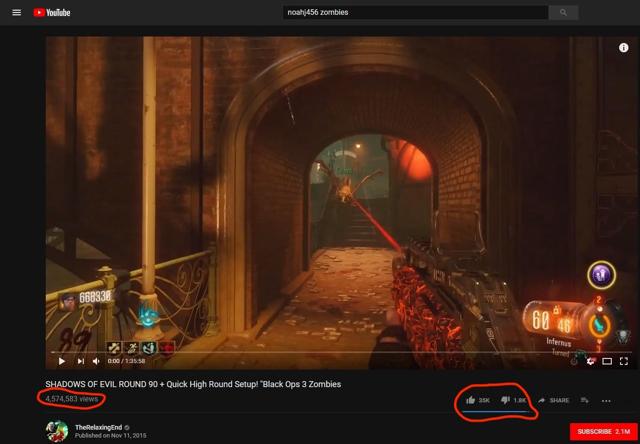
Source: Youtube (Famous Youtuber "TheRelaxingEnd" receives excellent video consumer metrics in content related to the Zombie mode within COD: BO3)

Battle Royale Mode Invention

COD: BO4��s newly created ��Battle Royale�� mode has been called ��Blackout��. According to Treyarch, the feature will be 1500x larger than the size of the map of Nuketown: a fan favorite setting that has appeared in every Black Ops title. The mode will allow for interaction with land, air, and sea vehicles as well. The video gaming community has reacted positively to this addition as a practicable result of recent clamor for the mode among games like ��Fortnite��. In addition, COD video gamers may now be able to play with their favorite characters, weapons, and equipment as the entire cache of the ��Black Ops�� series is accessible. However, Treyarch has not yet announced how many players may simultaneously play in the arena nor have they released Battle Royale oriented game-play besides cinematic clips. Although video game pundits cite ��100�� as the optimal number of players that should exist in a Battle Royale arena simultaneously, Treyarch has admitted that they will continue adjusting the settings until they have decided on a propitious outcome. A Battle Royale mode for COD: BO4 will be majorly responsible for this version��s magnitude of recurrent spending in the form of microtransactions. (Moderate Positive)
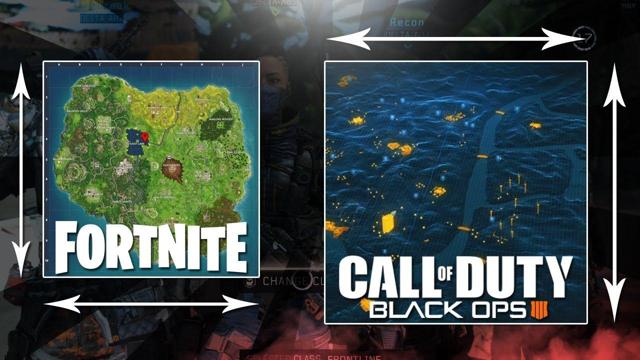
Source: Youtube (Youtuber Drift0r has calculated the immense scale of the COD: BO4 map which can be compared to relatively vast landscapes like Fortnite's map)

Qualitative Conclusions (COD: BO4��s place within shifting Business Economics)

The May 17th game-play reveal for COD: BO4 has demonstrated a classic-style COD game boasting a modern (contemporary or historical) setting whose characters are constricted to ��boots on the ground�� as well as a fine-tune Zombies mode and added Battle Royale feature which were made possible in the realization of a diminished or excluded campaign mode. The attention to detail, diverse range of playstyles, and Treyarch��s video game development prowess which reinforces the lauded ��Black Ops�� series brand has been given expression by the revealed game-play features. And it satiates, to more of an extent, than previous COD versions, what the COD and video gaming community at large has desired. Cinematic clips as supposed to unreleased game-play for the Battle Royale mode provide enough evidence for my prognostication of its successful reception come the game��s release October 12th, 2018. Additionally, the rapport with the video gaming community and the commercial success the release of COD: BO4 will secure is effectively aligned with the transforming business economics of video game publishing. As video game unit sales begin to dwindle as a percentage of Activsion��s total revenue, microtransactions within a given game franchise��s ecosystem has begun to proliferate and will do so to greater effect in the release of COD:BO4.

Driving Assumption behind Activision��s Secular Growth

I expect Black Ops 4 to sell over 20 million copies as the Black Ops series is the most played COD series in the franchise. With the legacy of the Black Ops series and a forecast of increased in-game play as a result of engaging multiplayer content available to the players, I expect COD: BO4 to build in number off of the quantity of unit copies sold from the previous title in the series, COD: WW2. Additionally, with a strong zombies mode, solid multiplayer experience, a Battle Royale mode, and potentially free downloadable content to be released to shore up the previous three features�� consumer reception, I expect the release of COD: BO4 to increase Activision��s total net revenue.

Quantitative Method/Conclusions

As attempts to discern from management what portion of Activision��s total net revenue is comprised of per unit sales of the COD franchise and the microtransactions syndicated through the series�� in-game environments, I have applied proxy measurements of the COD related proportions of product sales and microtransactions to all-time revenue incurred through each COD iteration. This was possible, in part, by knowing the 2017 COD version��s (COD: WW2) total copies sold and current total revenue achieved thus far��the remainder of the revenue incurred is inevitably the portion of spent microtransactions and other non-product sales. I have then scaled the growth of microtransactions in COD: BO4 from its predecessor versions based on PwC��s projections of the video game micotransaction CAGR between 2012 to 2021. Subsequently, I have calculated the total all-time revenue that COD: BO4 will incur within a similar time frame to which other COD series have recorded. I have then averaged (a conservative function in this scenario) the previous COD versions�� percent of Activision��s annualized product sales as well as microtransaction revenues or revenues classified under ��total subscription, licensing, and other revenues.�� In addition, I have adjusted this figure to the product sale and microtransaction all-time revenues forecast to achieve the expected revenue incurred throughout 2018. Note: the total net revenue that has been calculated has been discounted appropriately to include the first quarter of 2019 which would place COD: BO4��s all-time sales ��time range�� of measurement similar to that of previous COD versions for effective comparison. The result of these calculations has been consummated for the lack of reported revenue broken down by each contributing video game series that Activision has and will continue to publish in further versions. The result of this analysis has forecast operating revenue growth of 21% and microtransaction growth of 24%, which would then comprise 75% of total net revenues.
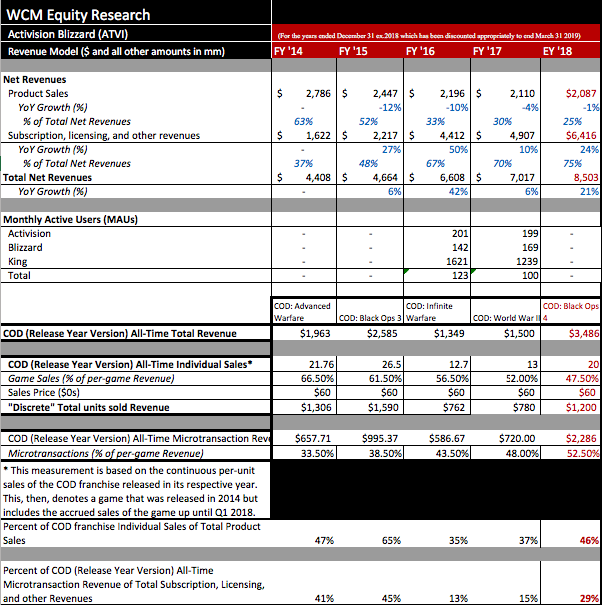
Source: Author's work

General Rebuttal Responses

Again, although the purported lack of a campaign mode or COD:BO4��s current visible semblance to COD: BO3 might create some frustration within the community, the COD franchise is lauded by its multiplayer base and added Zombies and Battle Royale modes will make the newest game in the series disparate from its predecessor. The net effects of current sentiment and evidenced features, will lead to an increase in Activision��s stock as the COD franchise remains an important product to Activision��s recurring commercial and artistic success. Additionally, analysts predicting a diminution of future sales of the newly announced COD game and its base for in-COD franchise customization spending, are only distracted by the disruptive Battle Royale based game Fortnite which has cleaved at the heels of established video games predominantly in Q1 2018 but whose features will be co-opted by COD: BO4 anyways. Further dispelling a dovish belief towards COD: BO4��s commercial reception, is the observable pattern manifest in the increasing level of involvement that video gamer players will begin portioning to larger video game publishers in the ensuing months where video game conferences and expected releases of well-known video game franchises become more publicized and engaged with at large.

After the game-play reveal this past May 17th, Call of Duty: Black Ops 4 reactions have been uploaded to social media platforms where opinions were expressed blatantly and in number for one to analyze the gaming community��s sentiment and predict the direction of future per-unit purchases or micro-transaction frequencies. Regardless,

The reveal livestream broke franchise records, including the most day one views as well as the highest concurrent viewers, while also blanketing social media as the #1 trending topic on Twitter globally during the broadcast. Views from the reveal event have already surpassed 80 million, including the livestream, official trailers and content creator videos.

(Note: This will be an expansive series which will result in further articles on Activision with focus both on qualitative and quantitative analysis.)

Disclosure: I/we have no positions in any stocks mentioned, and no plans to initiate any positions within the next 72 hours.

I wrote this article myself, and it expresses my own opinions. I am not receiving compensation for it (other than from Seeking Alpha). I have no business relationship with any company whose stock is mentioned in this article.

Sunday, May 27, 2018

Best Casino Stocks To Own For 2019

tags:INO,CLS,STOR, &l;p&g;Imagine you are at a roulette table in a casino and are given an opportunity for your lifetime savings of $500,000. You have two choices, A and B. If you choose option A, you will receive a monthly paycheck of $2,000 for the rest of your life. With option B, you could receive a monthly paycheck of $5,000 for the rest of your life.

The choice seems obvious, right? Not quite. If you read it correctly, option B does not offer the certainty of option A. The word &a;lsquo;could&a;rsquo; expresses possibility &a;ndash; and only possibility. That means there is a risk involved &a;ndash; a spin on the wheel. If it lands on red, you will receive the $5,000 monthly paycheck for the rest of your life, but if it lands on black, you receive nothing. Now, what do you do? Is the reward worth the risk?

That is the BIG question! Since I began focusing on income planning in 2005, four out of five clients I meet face this decision: the known versus the unknown, the certainty of a paycheck versus the possibility of making more money in the market. We refer to it as &a;lsquo;income planning&a;rsquo; versus &a;lsquo;income guessing.&a;rsquo;

Best Casino Stocks To Own For 2019: Inovio Pharmaceuticals, Inc.(INO)

Advisors' Opinion:
  • [By Joseph Griffin]

    Inovio Pharmaceuticals (NASDAQ:INO) last posted its earnings results on Wednesday, May 9th. The biopharmaceutical company reported ($0.36) earnings per share (EPS) for the quarter, missing analysts’ consensus estimates of ($0.14) by ($0.22). Inovio Pharmaceuticals had a negative net margin of 292.06% and a negative return on equity of 72.04%. The company had revenue of $1.53 million during the quarter, compared to analyst estimates of $7.50 million. During the same quarter last year, the business posted ($0.31) EPS. research analysts expect that Inovio Pharmaceuticals Inc will post -1.2 EPS for the current fiscal year.

  • [By Jim Robertson]

    On Tuesday, small cap�Inovio Pharmaceuticals (NASDAQ: INO) surged 22.63% after announcing�that its synthetic vaccine approach using a collection of synthetic DNA antigens generated broad protective antibody responses against all major deadly strains of H1 influenza viruses from the last 100 years. This includes�the virus that caused ��Spanish Flu�� in 1918. The study involved�multiple animal models, including mice, guinea pigs and non-human primates. Given how bad flu season is this year, the announcement got plenty of attention as�the following technical chart shows:��

Best Casino Stocks To Own For 2019: Celestica, Inc.(CLS)

Advisors' Opinion:
  • [By Peter Graham]

    A long term performance chart shows shares of small cap Sanmina Corp (NASDAQ: SANM), a previous Elite Opportunity Pro (EOP) newsletter suggestion as the next breakout stock, and�mid cap Flextronics International being bigger winners (albeit FLEX has steadily risen for two years while SANM has already peaked) compared with the moderately positive performance of mid cap Jabil Circuit, Inc (NYSE: JBL) and small cap Celestica Inc (NYSE: CLS):

  • [By Peter Graham]

    Nevertheless, a long term performance chart shows Sanmina Corp previously being an outperformer, but now falling off while�potential large cap peer Flextronics International Ltd (NASDAQ: FLEX) has given a steady performance over the last two years and small cap�Celestica Inc (NYSE: CLS) and mid cap�Jabil Circuit, Inc (NYSE: JBL) have similar unaspiring charts:

  • [By Ethan Ryder]

    These are some of the headlines that may have effected Accern Sentiment Analysis’s scoring:

    Get Celestica alerts: Global White Box Server Market Trend 2018- Quanta, Wistron, Inventec, Hon Hai, MiTAC, Celestica, Super Micro … (nwctrail.com) Taking Aim at Celestica Inc (CLS) Shares (parkcitycaller.com) When to Buy Opportunity? Celestica Inc. (CLS) (nysestocks.review) Electronic Manufacturing Services (EMS) Market 2018: Global Analysis by Key Players �� Foxconn, Flextronics, Celestica (industrytoday.co.uk) Riveting Stock Watch: Celestica Inc. (TSX:CLS) Earnings Growth in the Spotlight (derbynewsjournal.com)

    A number of equities research analysts have recently issued reports on the company. TheStreet upgraded Celestica from a “c+” rating to a “b-” rating in a research note on Monday, May 7th. Zacks Investment Research cut Celestica from a “hold” rating to a “sell” rating in a research note on Thursday, May 3rd. Royal Bank of Canada upped their price objective on Celestica from $11.00 to $12.00 and gave the stock a “sector perform” rating in a research note on Monday, April 30th. Finally, Beacon Securities reiterated a “buy” rating on shares of Celestica in a research note on Monday, January 29th. Two analysts have rated the stock with a sell rating, eight have assigned a hold rating and three have given a buy rating to the company’s stock. The stock has a consensus rating of “Hold” and a consensus price target of $13.27.

Best Casino Stocks To Own For 2019: STORE Capital Corporation(STOR)

Advisors' Opinion:
  • [By Shane Hupp]

    Stevens Capital Management LP bought a new position in shares of STORE Capital (NYSE:STOR) during the 1st quarter, according to its most recent 13F filing with the SEC. The fund bought 24,795 shares of the real estate investment trust’s stock, valued at approximately $615,000.

  • [By Todd Campbell, Rich Smith, and Neha Chamaria]

    Dividend paying stocks historically outperform non-dividend paying stocks, but that doesn't mean that all dividend paying companies are created equal. Some businesses are better than others, and the best businesses offer the greatest opportunity for future dividend increases. If you're hunting for top dividend stocks that offer more than just a high yield, it could be time to consider buying�CVS Health (NYSE:CVS), Welltower (NYSE:WELL), and STORE Capital (NYSE:STOR).

  • [By Lee Jackson]

    STORE Capital Corp. Inc. (NYSE: STOR) is the leader in the acquisition, investment and management of Single Tenant Operational Real Estate, which is its target market. Investors receive a 4.94% yield, and shares traded recently at $24.85. The 52-week range is $19.65 to $26.58. The consensus price target is $27.08.

  • [By Brian Feroldi, Leo Sun, and Demitrios Kalogeropoulos]

    Want proof? We asked these Motley Fool investors to highlight a dividend stock that pays a higher yield than Verizon. Here's why they picked�Tanger Factory Outlets (NYSE:SKT), Cedar Fair (NYSE:FUN), and�STORE Capital (NYSE:STOR).�

  • [By Keith Speights]

    Verizon Communications (NYSE:VZ), Store Capital Corporation (NYSE:STOR), and Sanofi (NYSE:SNY) are three Warren Buffett stocks that have especially high dividend yields of more than 4%. What does the Oracle of Omaha like about these stocks -- and are they smart picks for other investors right now?

Friday, May 25, 2018

Luxoft Sees Near-Term Weakness After a Challenging Year

Luxoft Holding�(NYSE:LXFT)�released solid fiscal fourth-quarter 2018 results early Thursday, highlighting sustained double-digit growth outside of its top two accounts and particularly strong showings from clients in the automotive and financial services markets.�

But the software development leader followed with disappointing forward guidance, leaving its shares to decline more than 24%�in response. So let's dig in to see exactly what drove Luxoft over the past few months and what investors should be watching in the coming quarters.

Two software engineers working together with multiple monitors displaying source code.

IMAGE SOURCE: GETTY IMAGES.

Luxoft Holding results: The raw numbers Metric

Fiscal Q4 2018*

Fiscal Q4 2017

Year-Over-Year Growth

GAAP revenue

$232.9 million

$204.1 million

14.1%

GAAP net income

$11.7 million

$13.7 million

(14.8%)

GAAP earnings per diluted share

$0.34

$0.40

(15%)

DATA SOURCE: LUXOFT HOLDING, *FOR THE THREE MONTHS ENDED MARCH 31, 2018.

What happened with Luxoft Holding this quarter? On an adjusted (non-GAAP) basis -- which excludes items like stock-based compensation -- net income declined 4.8% to $20.5 million, and fell 6.3% on a per-share basis to $0.59.�By comparison, most investors were looking for the same adjusted earnings on slightly lower revenue of $228.8 million.� Adjusted EBITDA�increased 0.7% to $29.4 million. Revenue by industry vertical included: 15.2% growth from financial services�to $133.6 million. 57.9% growth from automotive to $46.5 million a 10% decline from digital enterprise to $52.8 million. Annual revenue per billable engineer increased 10.5% year over year to $84,923. What management had to say

"Our fourth quarter results were largely in-line with our expectations and marked the end to a year of progress but also continued challenges," stated Luxoft CEO�Dmitry Loschinin. "Despite the impact of certain troubled accounts, we continued to execute our strategic mandate of revenue diversification through increased penetration of attractive markets like Automotive and Digital Enterprise, while also identifying incremental value-driven opportunities."

Loschinin also noted that, excluding Luxoft's top two accounts, revenue would have climbed 20.3% year over year, including 37.4% growth from the financial services market. He further credited Luxoft's relative outperformance in the automotive market to their "successful execution and delivery of innovative technologies, solutions, and experiences necessary to enable the mobility revolution."

Looking forward

For the first quarter of fiscal 2019, Luxoft told investors to expect revenue of $210 million to $215 million, the bottom end of which marks slight growth from $209.2 million in last year's fiscal Q1. But even the high end of Luxoft's guidance fell far below consensus estimates for revenue of $238.5 million.

"Based on project timing, seasonality, ramp down of the large Financial Services account and planned expenses related to SG&A optimization," Loschinin explained, "we expect this to be our slowest quarter and for growth to accelerate as we move through fiscal 2019."

Of course, that explains why our near-term-oriented market drove Luxoft shares down so aggressively on Thursday. But longer-term investors can take solace knowing that, if Luxoft is correct in predicting that growth will accelerate as they move through the fiscal year, its fall may prove short-lived. But in the meantime, it's no surprise to see the stock pulling back.

Thursday, May 24, 2018

Tokenomy Market Cap Reaches $30.34 Million (TEN)

Tokenomy (CURRENCY:TEN) traded 1.2% lower against the U.S. dollar during the one day period ending at 18:00 PM ET on May 24th. During the last week, Tokenomy has traded down 7.6% against the U.S. dollar. Tokenomy has a total market cap of $30.34 million and $258,901.00 worth of Tokenomy was traded on exchanges in the last day. One Tokenomy token can now be bought for about $0.24 or 0.00003211 BTC on exchanges.

Here’s how other cryptocurrencies have performed during the last day:

Get Tokenomy alerts: Ripple (XRP) traded up 3.7% against the dollar and now trades at $0.63 or 0.00008313 BTC. Stellar (XLM) traded 4% higher against the dollar and now trades at $0.29 or 0.00003869 BTC. TRON (TRX) traded up 3.7% against the dollar and now trades at $0.0730 or 0.00000962 BTC. IOTA (MIOTA) traded up 2.3% against the dollar and now trades at $1.52 or 0.00020106 BTC. NEO (NEO) traded 3% higher against the dollar and now trades at $54.53 or 0.00719204 BTC. Tether (USDT) traded 0.4% lower against the dollar and now trades at $1.00 or 0.00013177 BTC. VeChain (VEN) traded up 3.1% against the dollar and now trades at $3.68 or 0.00048560 BTC. Binance Coin (BNB) traded 2.2% higher against the dollar and now trades at $12.93 or 0.00170515 BTC. Zilliqa (ZIL) traded 3.7% higher against the dollar and now trades at $0.13 or 0.00001649 BTC. Ontology (ONT) traded 5.7% higher against the dollar and now trades at $6.75 or 0.00089019 BTC.

Tokenomy Token Profile

Tokenomy’s genesis date was January 20th, 2018. Tokenomy’s total supply is 200,000,000 tokens and its circulating supply is 124,607,148 tokens. Tokenomy’s official Twitter account is @TokenomyCom and its Facebook page is accessible here. Tokenomy’s official message board is medium.com/@tokenomy. Tokenomy’s official website is www.tokenomy.com.

Buying and Selling Tokenomy

Tokenomy can be bought or sold on the following cryptocurrency exchanges: Indodax. It is usually not presently possible to purchase alternative cryptocurrencies such as Tokenomy directly using U.S. dollars. Investors seeking to acquire Tokenomy should first purchase Bitcoin or Ethereum using an exchange that deals in U.S. dollars such as Coinbase, GDAX or Gemini. Investors can then use their newly-acquired Bitcoin or Ethereum to purchase Tokenomy using one of the exchanges listed above.

Seritage Growth Properties Forms New Real Estate Joint Ventures

In Seritage Growth Properties' (NYSE:SRG) 2017 annual report, CEO Benjamin Schall wrote that the real estate investment trust was likely to form joint ventures to redevelop many of its premier assets. Joint ventures can help Seritage tap into other companies' expertise for major projects. They are also an efficient way for the Sears Holdings spinoff to fund the redevelopment of its properties, due to buoyant demand among investors for private real estate.

It didn't take long for Seritage to get started. In March, it sold a 50% stake in The Mark 302 -- its downtown Santa Monica project -- to a unit of Invesco (NYSE:IVZ). Since then, Seritage has accelerated its efforts to form joint venture partnerships for some of its best assets, including two deals announced just this week.

Asset-rich but cash-poor

Seritage Growth Properties owns about 39 million square feet of retail real estate. Many of its properties are in great locations and have the potential to generate very high rents after being redeveloped.

However, Seritage produces virtually no cash flow today, because about 20% of its square footage is vacant and most of the remainder is still occupied by Sears and Kmart stores that pay very little rent. Furthermore, as of the end of March, the company had nearly $1.3 billion of debt, compared to only $135 million of unrestricted cash and $177 million of restricted cash.

Meanwhile, Seritage disclosed in its Q1 earnings report that it has nearly $900 million of spending planned for the next two years or so to finish its already-announced redevelopment projects.

Seritage's restricted cash includes $154 million reserved for redevelopment work. The $135 million of unrestricted cash is also available for this purpose. Nevertheless, Seritage Growth Properties clearly needs additional capital to complete its redevelopment activity. That's why it has been seeking joint venture agreements so eagerly.

An exterior rendering of Seritage's The Mark 302 project

Seritage sold a 50% stake in its Santa Monica property in March. Image source: Seritage Growth Properties.

Two new deals announced this week

On Tuesday, Seritage announced a second joint venture with Invesco Real Estate. Seritage sold a 50% interest in The Collection at UTC for $44 million to a separately controlled account that Invesco manages. The transaction values this project at $165 million upon completion. This implies that Seritage and Invesco will invest another $77 million to complete the redevelopment of this valuable site in San Diego, which entails replacing a Sears store with 226,200 square feet of highly desirable retail space.

Seritage also announced a second joint venture on Tuesday. First Washington Realty paid about $23 million for a 50% stake in The Corbin Collection, a redevelopment project in West Hartford, Connecticut, that is nearing completion. This deal values The Corbin Collection at $52 million, including the relatively small amount of redevelopment costs not yet incurred.

Seritage received proceeds of about $67 million from these two joint venture deals. It used most of that total to pay down mortgage debt associated with those properties. Additionally, Seritage and First Washington Realty took out a $20 million loan against The Corbin Collection. Seritage's share of $10 million can presumably help fund other redevelopment projects.

Importantly, these joint venture deals have reduced Seritage's future redevelopment obligations, since the joint venture partners will pick up half of the tab going forward. Between the two Invesco joint ventures and the new First Washington Realty deal, approximately $64 million of redevelopment costs will be transferred to joint venture partners.

There's more to come

Investors should expect Seritage to strike more joint venture agreements for its best properties in the next year or two. This is probably the single most cost-effective tool the company has for raising capital right now.

In fact, Seritage appears to have already reached a joint venture deal with Tucker Development to convert the last two Sears stores in the city of Chicago into mixed-use developments. These redevelopment projects and the partnership with Tucker Development haven't been formally announced, though.

Seritage is also likely to pursue a joint venture for its Esplanade at Aventura project, arguably its most desirable retail property. Planned mixed-use developments in Hicksville, New York, and Redmond, Washington, are also likely candidates for future joint ventures. These deals will help Seritage raise the capital it needs to transform its real estate portfolio and replace struggling Sears and Kmart stores with a diversified mix of tenants paying dramatically higher rents.

Tuesday, May 22, 2018

Monday’s Biggest Winners and Losers in the S&P 500

Source: ThinkstockMay 21, 2018: The S&P 500 closed up 0.7% at 2,733.03. The DJIA closed up 1.2% at 25,013.36. Separately, the Nasdaq was up 0.5% at 7,394.04.

Monday was a positive day for the broad U.S. markets. All three of the major averages started out positive for the day and held on to their gains throughout the session, with the Dow being the biggest winner. Crude oil started out the week with a bang, charging even further above the $70 price level. The S&P 500 sectors were entirely positive. The most positive sectors were industrials, real estate, and energy up 1.5%, 1.1%, and 0.9%, respectively. The ��worst�� performing sector was health care up only 0.1%.

Crude oil was up 1.6% at $72.40.

Gold was flat at $1,291.60.

The S&P 500 stock posting the largest daily percentage loss ahead of the close Monday was Fifth Third Bancorp (NASDAQ: FITB) which traded down about 8% at $30.94. The stock��s 52-week range is $23.20 to $34.67. Volume was nearly 27 million compared to the daily average volume of 5.2 million.

The stock posting the largest daily percentage gain in the S&P 500 ahead of the close Monday was Range Resources Corp. (NYSE: RRC) which rose about 6% to $16.05. The stock��s 52-week range is $11.93 to $25.96. Volume was 8.6 million compared to the daily average volume of 7.4 million.

Monday, May 21, 2018

Shiloh Industries (SHLO) Raised to “Hold” at ValuEngine

ValuEngine upgraded shares of Shiloh Industries (NASDAQ:SHLO) from a sell rating to a hold rating in a report issued on Friday morning.

Separately, Zacks Investment Research upgraded shares of Shiloh Industries from a sell rating to a hold rating in a research report on Wednesday, May 9th.

Get Shiloh Industries alerts:

Shares of NASDAQ SHLO opened at $9.89 on Friday. The company has a quick ratio of 1.09, a current ratio of 1.42 and a debt-to-equity ratio of 0.90. Shiloh Industries has a 52-week low of $6.45 and a 52-week high of $14.97. The company has a market capitalization of $230.87 million, a price-to-earnings ratio of 18.66 and a beta of 1.73.

Shiloh Industries (NASDAQ:SHLO) last announced its quarterly earnings results on Thursday, March 8th. The basic materials company reported $0.15 earnings per share (EPS) for the quarter, beating the Thomson Reuters’ consensus estimate of $0.01 by $0.14. Shiloh Industries had a net margin of 0.59% and a return on equity of 7.93%. The firm had revenue of $247.67 million during the quarter, compared to analysts’ expectations of $233.10 million. During the same period in the prior year, the company posted ($0.03) EPS. The company’s revenue was down .1% on a year-over-year basis. research analysts expect that Shiloh Industries will post 0.7 earnings per share for the current year.

In other Shiloh Industries news, VP Gary Dethomas sold 3,733 shares of the company’s stock in a transaction that occurred on Wednesday, March 14th. The shares were sold at an average price of $8.65, for a total value of $32,290.45. Following the completion of the transaction, the vice president now directly owns 15,875 shares in the company, valued at approximately $137,318.75. The sale was disclosed in a filing with the SEC, which is available at this hyperlink. Corporate insiders own 37.40% of the company’s stock.

Hedge funds and other institutional investors have recently made changes to their positions in the business. Alambic Investment Management L.P. increased its position in shares of Shiloh Industries by 4.9% during the fourth quarter. Alambic Investment Management L.P. now owns 158,930 shares of the basic materials company’s stock worth $1,303,000 after buying an additional 7,400 shares during the period. Two Sigma Advisers LP increased its position in shares of Shiloh Industries by 47.8% during the fourth quarter. Two Sigma Advisers LP now owns 23,800 shares of the basic materials company’s stock worth $195,000 after buying an additional 7,700 shares during the period. California State Teachers Retirement System increased its position in shares of Shiloh Industries by 50.6% during the third quarter. California State Teachers Retirement System now owns 23,200 shares of the basic materials company’s stock worth $241,000 after buying an additional 7,800 shares during the period. Teachers Advisors LLC increased its position in shares of Shiloh Industries by 46.9% during the fourth quarter. Teachers Advisors LLC now owns 27,653 shares of the basic materials company’s stock worth $227,000 after buying an additional 8,833 shares during the period. Finally, Strs Ohio increased its position in shares of Shiloh Industries by 14.6% during the fourth quarter. Strs Ohio now owns 76,800 shares of the basic materials company’s stock worth $629,000 after buying an additional 9,800 shares during the period. Hedge funds and other institutional investors own 47.58% of the company’s stock.

About Shiloh Industries

Shiloh Industries, Inc, together with its subsidiaries, provides lightweighting, noise, and vibration solutions to automotive, commercial vehicle, and other industrial markets worldwide. The company produces body systems components, including shock towers, instrument panel/cross car beams, torque boxes, tunnel supports, seat supports, seat back frames, hinge pillars, lift gates, door inners, roof supports/roof panels, dashpanels, body sides, and B and C pillars; and chassis systems components, such as cross members, frame rails, axle carriers, bearing caps, axle covers and housings, clutch housings, PTU covers, axle tubes, rack and pinion housings, steering column housings, knuckles, links, wheel hubs, calipers, master cylinders, steering pumps, brake components, wheel blanks, and flanges.

To view ValuEngine’s full report, visit ValuEngine’s official website.

Sunday, May 20, 2018

Insider Selling: Old National Bancorp (ONB) Director Sells 1,064 Shares of Stock

Old National Bancorp (NASDAQ:ONB) Director Katherine E. White sold 1,064 shares of the company’s stock in a transaction dated Wednesday, May 16th. The shares were sold at an average price of $17.80, for a total transaction of $18,939.20. Following the transaction, the director now owns 1,243 shares in the company, valued at approximately $22,125.40. The transaction was disclosed in a filing with the SEC, which is accessible through the SEC website.

Shares of Old National Bancorp remained flat at $$17.85 during midday trading on Friday, according to MarketBeat. 891,112 shares of the stock traded hands, compared to its average volume of 849,262. Old National Bancorp has a 12-month low of $15.38 and a 12-month high of $18.88. The stock has a market cap of $2.72 billion, a price-to-earnings ratio of 15.39 and a beta of 0.88. The company has a quick ratio of 0.86, a current ratio of 0.86 and a debt-to-equity ratio of 0.88.

Get Old National Bancorp alerts:

Old National Bancorp (NASDAQ:ONB) last released its quarterly earnings results on Monday, April 23rd. The bank reported $0.34 EPS for the quarter, beating the Thomson Reuters’ consensus estimate of $0.29 by $0.05. Old National Bancorp had a net margin of 15.23% and a return on equity of 8.18%. The firm had revenue of $170.96 million during the quarter, compared to analyst estimates of $170.43 million. During the same quarter in the prior year, the firm earned $0.27 EPS. analysts forecast that Old National Bancorp will post 1.26 EPS for the current fiscal year.

The firm also recently declared a quarterly dividend, which will be paid on Friday, June 15th. Stockholders of record on Friday, June 1st will be given a dividend of $0.13 per share. This represents a $0.52 annualized dividend and a dividend yield of 2.91%. The ex-dividend date of this dividend is Thursday, May 31st. Old National Bancorp’s payout ratio is currently 47.27%.

Several hedge funds and other institutional investors have recently added to or reduced their stakes in the company. Aperio Group LLC increased its position in shares of Old National Bancorp by 5.7% during the 4th quarter. Aperio Group LLC now owns 54,676 shares of the bank’s stock valued at $954,000 after purchasing an additional 2,959 shares during the last quarter. Profund Advisors LLC increased its position in shares of Old National Bancorp by 14.7% during the 1st quarter. Profund Advisors LLC now owns 23,574 shares of the bank’s stock valued at $398,000 after purchasing an additional 3,027 shares during the last quarter. LPL Financial LLC increased its position in shares of Old National Bancorp by 12.7% during the 1st quarter. LPL Financial LLC now owns 29,664 shares of the bank’s stock valued at $501,000 after purchasing an additional 3,336 shares during the last quarter. US Bancorp DE increased its position in shares of Old National Bancorp by 27.2% during the 4th quarter. US Bancorp DE now owns 16,711 shares of the bank’s stock valued at $292,000 after purchasing an additional 3,571 shares during the last quarter. Finally, HBK Investments L P increased its position in shares of Old National Bancorp by 20.6% during the 4th quarter. HBK Investments L P now owns 21,100 shares of the bank’s stock valued at $368,000 after purchasing an additional 3,600 shares during the last quarter. 66.03% of the stock is owned by hedge funds and other institutional investors.

Several equities analysts have issued reports on ONB shares. Zacks Investment Research upgraded shares of Old National Bancorp from a “sell” rating to a “hold” rating in a research note on Thursday, April 26th. Boenning Scattergood restated a “buy” rating on shares of Old National Bancorp in a research note on Wednesday, March 28th. BidaskClub cut shares of Old National Bancorp from a “sell” rating to a “strong sell” rating in a research note on Friday, January 26th. Hilliard Lyons upgraded shares of Old National Bancorp from a “neutral” rating to a “buy” rating and set a $19.00 target price on the stock in a research note on Friday, February 9th. Finally, Keefe, Bruyette & Woods restated a “hold” rating and set a $20.00 target price on shares of Old National Bancorp in a research note on Tuesday, February 27th. Eight equities research analysts have rated the stock with a hold rating and three have issued a buy rating to the stock. The stock presently has an average rating of “Hold” and a consensus price target of $19.25.

Old National Bancorp Company Profile

Old National Bancorp operates as the holding company for Old National Bank that provides various financial services to individual and commercial customers in the United States. The company offers deposit accounts, including noninterest-bearing demand, NOW, savings and money market, and time deposits; and loans, such as home equity lines of credit, residential real estate loans, consumer loans, commercial loans, commercial real estate loans, letters of credit, and lease financing.